We are visiting Key West, Florida later this week via our 7-Day Western Caribbean cruise on Holland America’s Nieuw Amsterdam. While we’ve visited this city several times before, we’ve never researched it. It turns out there are many interesting facts about Key West.
 53 Fun Facts About Key West, Florida
1. The Florida Keys were first inhabited by the Tequesta and Calusa Native American tribes.
2. Cayo Hueso was the original name for Key West was which means “Island of Bones.” The term “key” comes from the Spanish word “Cayo“ meaning “small island.” Early native inhabitants used the island as a mass graveyard, causing it to be littered with bones.
3. In 1521 Ponce de Leon — a Spanish explorer, crew member for Christopher Columbus and former governor of Puerto Rico — was the first European to visit Key West. Leon found Key West by mistake while searching for the fountain of youth. A small Spanish colony of fishermen was established.
4. In 1763, Great Britain took control of Florida. The Spanish and Native Americans inhabiting the Key West area were moved to Havana.
5. Florida returned to Spanish control 20 years later, but there was no official resettlement of Key West. Fishermen from Cuba, Great Britain, and the newly independent U.S. used the island informally, as no nation exercised de facto control over the community there for some time.
6. In 1815, the Spanish governor of Cuba in Havana deeded the island of Key West to Juan Pablo Salas, an officer of the Royal Spanish Navy Artillery posted in Saint Augustine, Florida.
7. In 1822, Lt. Commander Matthew C. Perry sailed the schooner Shark to Key West and planted the U.S. flag, claiming the Keys as United States property. Since no protests were made to American claim on Key West, the Florida Keys became the property of the United States.

Key West from space.
8. After Florida was transferred to the United States, Salas sold the island of Key West to U.S. businessman John W. Simonton for the equivalent of $2,000 U.S. dollars.
9. Simonton bought the island on the advice of his friend John Whitehead, who had been stranded in Key West after a shipwreck in 1819 and had been impressed by the potential of the island’s deep harbor. The island was considered the “Gibraltar of the West” because of its strategic location on the 90-mile wide Straits of Florida deep shipping lane, between the Atlantic Ocean and the Gulf of Mexico.
10. Soon after his purchase, Simonton lobbied successfully for the building of a naval base. He subdivided the island into plots and sold them to three different business men.
11. In 1823, U.S. Navy Commodore David Porter took charge of Key West, which he ruled as military dictator under martial law. Porter was tasked to establish a Naval Base was stop piracy in the area.
12. During the 1830’s, an increasing number of ships sailed along the Keys moving goods along trade routes between the US east coast, the Gulf of Mexico, and the Caribbean Sea. The combination of strong currents and dangerous reefs resulted in frequent shipwrecks, as often as one per week.
13. Many Key West inhabitants worked salvaging shipwrecks from nearby Florida reefs. Key West became the wealthiest city per capita in the United States in the 1830s, thanks to treasure retrieval from shipwrecks off the coast. Local homes contained an unusually high concentration of fine furniture and chandeliers received from shipwrecks.
14. While Florida seceded and joined the Confederate States of America during the American Civil War, Key West remained in U.S. Union hands because of the naval base. Many locals, however, were sympathetic to the South, and flew Confederate flags over their homes.

Photograph of the central yard of Fort Zachary Taylor, Key West, Florida, USA taken by Rolf Mí¼ller.
15. Fort Zachary Taylor, constructed from 1845 to 1866, was an important Key West outpost during the Civil War. In 1861, construction began on two other forts, East and West Martello Towers, which served as side armories and batteries for Fort Taylor connected by railroad tracks.
16. In January 1898, The Battleship USS Maine was sent from the naval base in Key West, Florida, to Havana, Cuba, to protect U.S. interests during the Cuban War of Independence against Spain. Three weeks later, the Maine exploded without warning, and sank quickly in the Havana Harbor, killing nearly three quarters of her crew.
17. Crewmen from the ship are buried in Key West, and the Navy investigation into the blast occurred at the Key West Customs House. While the responsibility for her sinking remained unclear, popular opinion blamed Spain. “Remember the Maine, to Hell with Spain”, became a rallying cry, leading to the Spanish – American War later that year.
18. During Cuba’s unsuccessful war for independence from Spain, many Cubans sought refuge in Key West, bringing with them a thriving cigar-making industry. Cubans set up 200 factories in town, producing 100 million cigars annually.
19. Many of the residents of Key West were immigrants from the Bahamas, known as Conchs (pronounced ‘conks’), who arrived in increasing numbers after 1830. Many were sons and daughters of Loyalists who fled to the nearest Crown soil during the American Revolution.
20. In the 20th century many residents of Key West started referring to themselves as “Conchs”, and the term is now generally applied to all residents of Key West. Some residents use the term “Saltwater Conch” to refer to a person born in Key West, while the term “Freshwater Conch” refers to a resident not born in Key West but who has lived in Key West for seven years or more.
21. The area next to Fort Taylor became a submarine pen and was used for the Fleet Sonar School. A house built on the submarine base naval station in 1890 — today known as the Truman White House — served as the first officer’s quarters, and was converted into a single-family dwelling to house the base commandant in 1911.

Aerial view of Trumbo Point showing Florida East Coast Railway terminal, docks, and railyard in Key West around 1930.
22. Railroad tycoon Henry Flagler completed his impossible “railroad that went to sea,” in January, 1912, connecting Key West with the mainland and providing a way for wealthy visitors to travel to the Keys for warm-weather vacations
23. William Howard Taft was the first President to visit what is now known as the Truman Annex when he arrived by Flagler’s Overseas Railroad in December 1912, before sailing to Panama to inspect the canal then under construction.
24. During World War I, Thomas Edison lived in the military headquarters while he donated his services to the war effort, perfecting 41 weapons during his six month stay. The house remained command headquarters through World War II.
25. Pan American World Airways, commonly known as Pan Am, was founded in Key West, with its first flight on October 18, 1927 to deliver mail between Cuba and the United States under a contract with the with the United States Postal Service.

Key West is the birthplace of Pan American World Airways, known as Pan Am. Photo by alexdecarvalho.
26. The first international commercial passenger flight left from Key West on January 16, 1928 when Pan American airlines flew seven passengers aboard a Fokker F-7 plane from Key West to Havana, Cuba.
27. In 1935, Key West and the other Florida Keys were hit by the Labor Day Hurricane with wind speeds of 200 miles per hour. More than 500 people died in the hurricane and the bridges of the Overseas Railway were severely damaged.
28. The U.S. government then rebuilt the rail route as the Overseas Highway, completed in 1938, which became an extension of United States Highway 1, running from Key West, Florida to Fort Kent, Maine. Franklin Roosevelt toured the road in 1939.
29. At the beginning of World War II, the Navy increased its presence in Key West from 50 acres to 3,000 acres by encompassing all of Boca Chica Key’s 1,700 acres and constructing Fleming Key from landfill. The Navy built the first water pipeline extending the length of the keys, bringing fresh water from the mainland to supply its bases.
30. The Harry S. Truman Little White House in Key West became the winter White House for President Truman after his doctor, Wallace Graham, ordered a warm vacation. President Truman made 11 visits to Key West, staying a total of 175 days during his presidency.
31. Documents issued from the Little White House read, The White House, US Naval Station, Key West, Florida.
32. In addition to Truman, Dwight D. Eisenhower stayed in Key West following a heart attack. In November 1962, John F. Kennedy visited Key West a month after the resolution of the Cuban Missile Crisis.


33. The house served as the Naval Station commandant’s house until March 1974, when the submarine base was closed. The house was opened as a state historic site and museum in 1991, and guided tours take visitors to see the rooms where the president lived and worked. Items such as President Truman’s briefcase, books, telephone, and his famous “The Buck Stops Here
34. Key West was flooded with refugees during and after the Mariel Boatlift in May, 1980. In 1982, the U.S. Border Patrol set up a blockade on U.S. 1, where the Overseas Highway meets the mainland at Florida City to search cars returning to Florida’s mainland for illegal immigrants and drugs. This roadblock jammed traffic for up to 17 miles, paralyzed the Florida Keys, which rely heavily on the tourism industry.
35. On April 23, 1982, Key West Mayor Dennis Wardlow declared the city as independent and renamed it the Conch Republic in a protest of the blockades. While the city’s secession was short-lived, Conch Republic flags, T-shirts and other merchandise are still popular souvenirs for visitors to Key West, and the Conch Republic Independence Celebration occurs every April 23rd.
36. Duval Street, Key West’s main street, is named after Florida’s first territorial governor, who served between 1822 and 1834.

The Mel Fisher Maritime Heritage Museum in downtown Key West, Florida. Photo by Digital photo taken by Marc Averette.
37. The Mel Fisher Maritime Museum, founded by the legendary shipwreck salvager, houses the largest single collection of 17th-century maritime and shipwreck antiquities in the Western Hemisphere – mostly excavated from the waters around Key West.
38. In 1928, Ernest Hemingway is said to have written part of A Farewell to Arms 
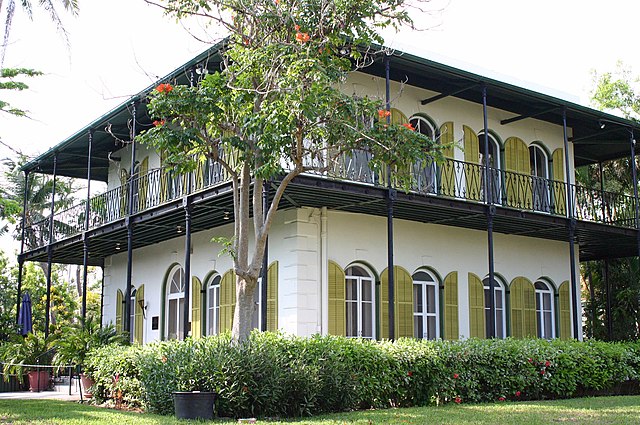
The Ernest Hemingway House, a popular tourist attraction in Key West.
39. Pauline’s uncle Gus also bought the couple the house at 907 Whitehead Street as a wedding present in 1931. The Hemingway House was the first home in Key West to boast with running water and a swimming pool.
40. Hardware store owner Charles Thompson introduced Ernest Hemingway to deep-sea fishing. Joe Russell (also known as Sloppy Joe) was among the group of friends who fished, and was reportedly the model for Freddy in To Have and Have Not. Hemingway used Depression-era Key West as one of the locations in To Have and Have Not
41. Thompson’s fishing group had nicknames for each other, and Hemingway wound up with “Papa”.
42. During his stay in Key West Hemingway also wrote or worked on Death in the Afternoon


43. Pauline and Hemingway divorced in 1939; Hemingway only visited Key West occasionally when returning from Havana until his suicide in 1961.
44. Today the Hemingway House is home to more than 60 six- or seven-toed polydactyl cats descended from Hemingway’s original pet “Snowball”.
45. Tennessee Williams first became a regular visitor to Key West in 1941 and is said to have written the first draft of A Streetcar Named Desire 

46. In 1949, Tennessee Williams bought a modest bungalow at 1431 Duncan Street. While Williams rented homes all over the U.S, the only one he ever owned was in Key West, which he listed as his primary residence until his death in 1983. Today the Williams home is privately owned and not open to the public.
47. A brightly-painted concrete buoy at the corner of South and Whitehead Streets is one of the most photographed visitor attractions in Key West. Erected in 1983, it claims to mark the southernmost point in the contiguous United States. Whitehead Spit, on U.S. Navy property just west of the buoy, is the true southernmost point, but cannot be visited by civilian tourists.
48. The buoy monument also claims that it is located “90 Miles to Cuba.” The closest point to Cuba is actually 94 statute miles from Key West, while Miami is 160 miles away by car.

View of Duval Street in Key West, Florida.
49. The original Key West settlement on the western part of the island is called “Old Town” and includes Mallory Square, Duval Street, the Truman Annex and Fort Zachary Taylor. Most of the buildings in this area are wood-frame construction and date from 1886 to 1912.

 Key West – 1000 Piece Jigsaw Puzzle
50. The “New Town” section on the eastern part of the island was created with landfill, more than doubling the size of Key West. New Town houses shopping centers, retail malls, residential areas, schools, ball parks, and Key West International Airport.
51. The”Lobsters” in Key West are actually saltwater Crawfish.
52. In 1978, Charles “Sonny” McCoy, the mayor of Key West, water-skied to Cuba, making the trip in 6 hours, 10 minutes on a slalom ski.
53. Key West has the highest average temperature of any city in the United States, and never freezes. The all-time record high temperature in Key West is 97 °F on July 19, 1880, and August 29, 1956.
Learn more about Key West, Florida with these resources:


 Key West: History of an Island of DreamsHemingway’s Key West
What fun fact about Key West can you add to this list?
Interact with us on Twitter, Facebook, Pinterest or Instagram.
Other fun facts to discover: