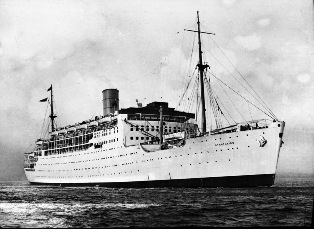
When people think of famous ships they may think of the Titanic, the Queen Elizabeth, Carnival’s Mardi Gras, the Queen Mary 2, or the Sovereign of the Seas. Or they may think of Royal Carribean’s Oasis of the Seas or Allure of the Seas or Harmony of the Seas, currently the largest cruise ships afloat at sea.
We rarely think of the way cruise ships came into being or how they have gradually gotten very popular over the years.
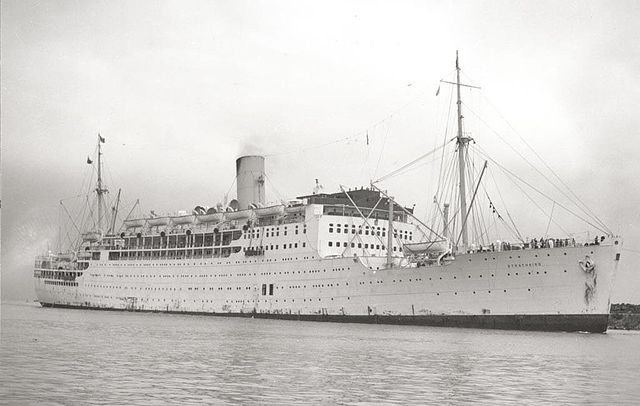
“Strathaird” Cruise Liners from P & O Cruises. Photo from 1950.
Here is a timeline of the evolution of the cruise ship:
1815: Before it was P&O Cruises (which is still running today), it was Wilcox and Anderson – a ship brokering firm originally founded by Brodie McGhie Wilcox and Arthur Anderson for trading between England and the Iberian Peninsular countries of Spain and Portugal.
Wilcox and Anderson eventually became The Peninsular and Oriental Steam Navigation Company (P&O) in 1822.

A P & O steamer in Venice, circa 1870.
1833: Some sources recognize the Francesco I, flying under that flag of the Kingdom of the Two Sicilies (a predecessor of Italy), as one of the first cruise ship sailings. Nobles, authorities, and royals boarded the Francesco I, and cruised to 11 countries within three months. Since the sailing was limited to European aristocrats, it was not considered to be a commercial cruise.
1840: Wilcox and Anderson (P&O) were awarded new mail contracts to extend their services to the Egyptian Port of Alexandra. Their new contract required that the voyage from England to Alexandria should be accomplished within 15 days. This is when the two men realized that they could do much more with their trade than merely travel, export, and mail.
1844: P&O introduced “leisure excursions” that allowed passengers to travel to the Iberian Peninsula and the Mediterranean from Southhampton. As the forerunner of modern cruises with these voyages, has led P&O Cruises to be recognized as the world’s oldest cruise line.
1867: The ship, Quaker City, was the first cruise from New York to Europe.
1880: The P&O ship the Ravena was the first ship to be constructed as a 100 per cent steel superstructure.
1889: The SS Valetta was the first ship to use electric lights
1891: Augusta Victoria was a German ship which carried 241 passengers and expanded the cruise ship to a wider market.
1900: The first ship that was built exclusively for luxury cruising was the Prinzessin Victoria Luise of Germany.

Prinzessin Victoria Luise
1912: The Titanic sank which stimulated the improvement of safety on cruise ships.
In 1914: otherwise the beginning of WWI, all production of cruising came to a halt.
1922: The first world cruise was made by Laconia, a British Conard Line which lasted six months.

Some women watching the Laconia as it sails away. Photo curtesy of Wallsend Local History Society
1927: Ile de France, made by the French, was a passenger ship that was completely decorated in a modern, contemporary style and introduced the now-famous art-deco style and ended the era of the classic, severe interior of the cruise ships.
1939 to 1945: During World War II, many cruise ships were used to transport troops including the Queen Mary, Aquitania, Cap Arcona, Laconia, Queen Elizabeth, and the Orontes. Many ocean liners were destroyed during the war.
And from then on cruises have then been built larger, grander,–providing the best experiences for those who seek them.
2009: Royal Caribbean International launched the Oasis of the Seas, the first in it’s Oasis-class of ships. With a gross tonnage of 224,282 and a displacement of approximately 100,000 metric tons, the Oasis-class ships are the world’s largest passenger ships, carrying a maximum of 6,296 guests and approximately 2,200 crew members. Oasis-class ships feature a split structure, with the 5-deck high “Central Park” and “Boardwalk” outdoor areas running down the middle of the ship. These ships feature a lush tropical garden, a zip line, two Flow Riders, two rock climbing walls, an AquaTheater with divers performing off of a 60ft platform, and a working carousel.
Learn more about the cruise ship industry with these resources:
A Cruise Ship Primer: History & Operations


Dead Wake: The Last Crossing of the Lusitania


This post is written by Megan Bryde, a forever student of the world while also finishing up her bachelors in English at Truman State University this semester.
Involved in too many activities, she sings as loud as she can, writes, cooks, bakes, and drinks a lot of coffee.
Megan is currently completing an internship with VentureTime Travel and aspires to be teaching English someday.
For more history of cruising information, check out these posts:
- Celebrating 20 Years of Cruising: What Has Changed Versus What Has Stayed the Same
-
Comparing Cruising 100 Years Ago: The Titanic Exhibit at Kansas City’s Union Station
Reach out to us via Twitter or interact with us on Facebook.