We will be visiting Cochin, India, soon, while on a cruise ship. Since we will only have a day in the city, we wanted to learn more about the it before our visit.

A night view of Marine Drive in Cochin, India. Photo by Augustus Binu.
Here are 24 Interesting Facts about Cochin (Kochi) India:
1. Cochin is the colonial name of Kochi, India, a major port city by the Arabian Sea on the southern part of India’s west coast.
2. Since the 14th Century, Kochi has been an important spice trading center on the west coast of India, connecting the mainland to the rest of the world and known as the “Queen of the Arabian Sea.”
3. Kochi’s rise to fame began in 1340 AD, when massive flooding of the Periyar River destroyed the world-famous port at Cranganore, while also creating a natural harbor at the nearby city of Kochi.
4. With its strategic location on the international seafaring route between Europe, the Middle East, Asia and the Pacific Rim, the harbor of Kochi soon developed into a major world trading center for high-quality pepper, cardamom, cinnamon and cloves.
5. Kochi has been ruled by numerous empires. Occupied by the Portuguese Empire in 1503, Cochin was the first of the European colonies in colonial India. Chochin was the main seat of Portuguese India until 1530, when Goa was chosen instead.
6. Under the Portuguese, Cochin grew into a prosperous town and in 1530 AD built a fort at called ‘Manuel Kotta’ (Fort Emmanuel).
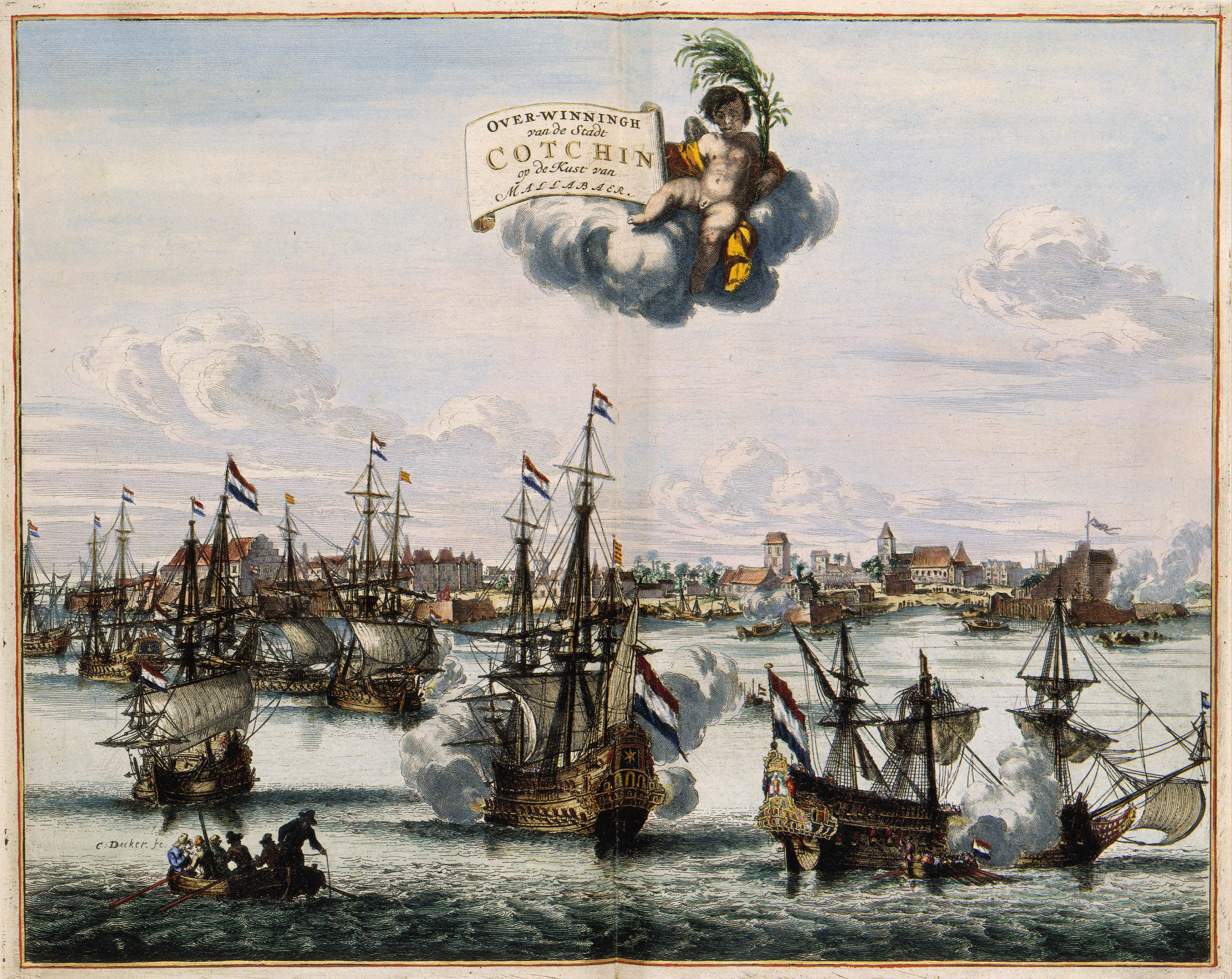
The capture of Kochi and victory of the Dutch V.O.C. over the Portuguese in 1656-A Dutch painting (c.1682)
7. The Dutch invaded Cochin in 1653 and took over rule from the Portuguese in 1663.
8. The Dutch then built Fort Williams in Cochin but were defeated by the great rulers of Mysore – Hyder Ali and Tipu Sultan.
9. When India lost to the British in 1814, Cochin became a part of the British Empire.
10. After India became independent in 1947, the state of Kerala was formed by the unification of provinces Kochi, Malabar and Travancore in 1956. Kochi was formed in 1967 by the merger of the towns – Fort Kochi, Mattanchery, Ernakulam and many nearby villages.
11. The Arabs, British, Chinese, Dutch, and Portuguese all impacted the history and development of Cochin. The English claimed Cochin as ‘Mini England’, the Dutch called it ‘Homely Holland’ and the Portuguese referred to the port as ‘Little Lisbon’.
12. Italian traveler Nicolas Conti wrote in his travelogue: “China is where you make your money, then Cochin is surely the place to spend it.“
13. Today, Cochin is the headquarters of India’s Southern Naval Command, home to the Navy’s main training center, an air station, and the leading gunnery school all located on Willingdon Island.

Cochin fishermen use massive fishing nets called Cheenavala. Photo by Jorge Royan.
14. The coast between Fort Kochi and Vypeen is covered with fishermen earning their livelihood by fishing with giant nets called Cheenavala. Outside of China, these massive fishing nets are only found in Cochin, and are believed to have been introduced to the port city by Chinese traders under the court of Kublai Khan.
15. While Malayalam is the official language of the state of Kerala, English is widely spoken.
16. Cochin residents practice a range of religions, with the population including Hindus, Christians, Muslims, Jains, Jews, and Sikhs.

The view in Cochin from the southern end of the Musical Walkway adjoining the Fishing Net Bridge.
17. Cochin averages 132 days of rain each year, especially during the June to September southwest monsoons and the northeast monsoons between October and December. The best time to visit is between October and March.
18. Tourists often enjoy boat rides through the backwaters – dotted with many small islands – that separate Ernakulam from Fort Kochi and Mattanchery.
19. Ninety percent of all of the pepper that India produces is traded through the International Pepper Exchange at Kochi.

St. Francis Church, the oldest European-built church in India. Photo by Vineethv2.
20. St. Francis Church, the oldest church built by Europeans in India, contains a clearly-marked burial spot for Portuguese trader Vasco da Gama, who died in Cochin during his third visit. Vasco was buried in the St. Francis Church, but his remains were later taken back to Portugal.
21. The Vasco house, located on Rose Street in Fort Kochi, is one of the oldest Portuguese houses in India and features European glass pane windows and verandahs.
22. Santa Cruz Basilica, the original Catholic Church in Fort Kochi, was built by the Portuguese in 1505 and named as a cathedral in 1558. The current structure dates to 1905 and was made a basilica by Pope John Paul II in 1984.
23. The Jewish Synagogue, located near the Dutch Palace in Mattancherry, was built in 1568. It’s decorated with magnificent Chinese tiles and Belgian chandeliers, and houses giant scrolls of the Old Testament.
24. Cochin’s best buys for shoppers include metal ware, wood carvings, and articles made of coconut shells, bamboo cane, or rattan. Shops generally open at 10 am and close around 8 pm, and are closed on Sundays.
Have you visited Cochin? What “fun fact” can you add to this list?
To learn more about Cochin, India, check out these resources:


Other Fun Facts posts: