History, Wine, and Gateway to the Dolomites

Views of the Dolomites from the hiking trails near Bolzano/Bozen, Italy
Near Italy’s northern border, the city of Bolzano/Bozen is a gateway to the Dolomites, the majestic white mountain peaks that are part of the Alps.
Bolzano is the city’s Italian name while Bozen is its German name. Bolzano/Bozen is the capital of the multilingual province of Alto Adige/South Tyrol, ceded by Austria to Italy at the end of World War I.
This autonomous province has a special statute that preserves the rights of the German minority in this part of Italy. All signs are in Italian and German.
Three languages spoken, not including English
Three native languages are spoken by residents of South Tyrol: Italian, German and Ladin, a Rhaeto-Romance language dating to the Roman era.
A historic city and cultural cross point.
The Romans built settlements around 15 BC. Bavarians migrated to the area after the downfall of the Roman Empire, establishing Bozen around 679 AD.
By 1190, Bozen became an official town and key trading destination between Venice and Augsburg, with a four-time-per-year market drawing traders from the north and south.
Today Bolzano/Bozen remains a cultural cross point between the Germanic and Mediterranean worlds.
Otzi the Iceman
Today in Bolzano, you can visit Otzi – a man who died between 3350 -3300 BC – at the South Tyrol Museum of Archaeology. Discovered in 1991 eroding from glacier in the surrounding Italian Alps, Otzi’s body was perfectly preserved in a crevasse for more than 5000 years.
A wine region since pre-Roman days
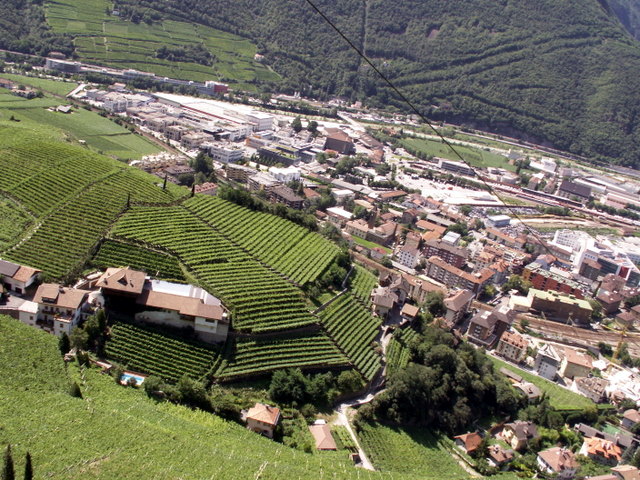
View of grape vines from the cable car.
Bolzano has been producing wine since pre-Roman times – it’s estimated there are 40 vines for every resident – fueling the saying “If Venice floats on water, then Bolzano floats on wine.”
This blog post inspired us to find Enovit Vinoteque, a wine shop and tasting bar with samples poured by Elisabetta Anderle. We found the place just as the blogger describes it, perfect for observing the Bolzano culture while enjoying its tasty wines.
Three cable car routes to high plateaus
Bolzano is located in a broad valley basin surrounded by mountains. Three different cable cars, including the world’s first passenger cable car from 1908, transport you up to the mountains to the high plateaus, where hiking trails offer magnificent views of the surrounding Dolomites.
The Renon/Ritten cable car whisks you straight up the mountain, passing over grape vine-covered steep hillsides and valleys to the mountain town of Soprabolzano/Oberbozen.
On the ride, the Dolomites appear in the distance. In Soprabolzano, enjoy a glass of inexpensive local wine at Café Fink while waiting catch the tram to Klobestein/Collalbo. On this 20 minute ride, the Dolomites become more pronounced.
Hiking Trails Abound
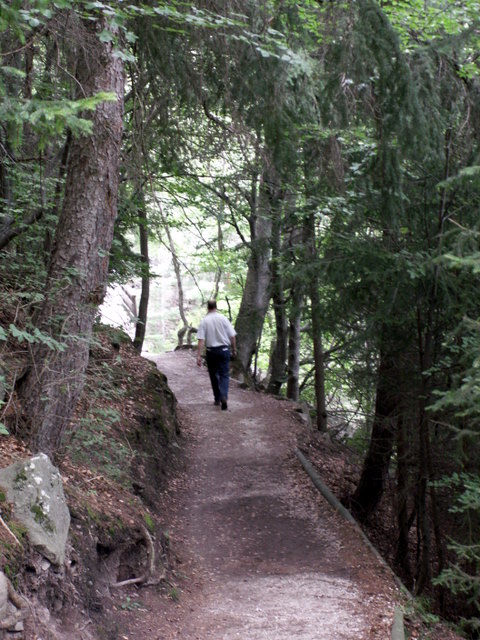 From Collalbo, we hiked on a well- maintained trail marked with a baby carriage symbol, later learning that meant the path was relatively flat. Regardless, the trail provided stunning views, with cafes along the offering coffee, apple strudel or a glass of wine.
Our hiking route passed the Longomoso Pyramids, eroded earth pillars capped with stone “hats”.
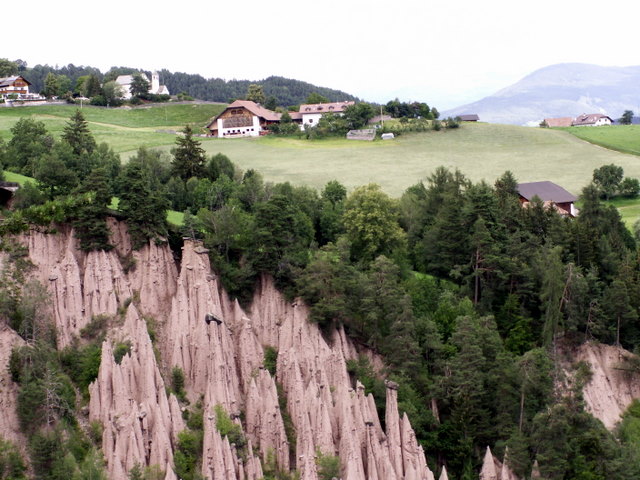
The Longomoso Pyramids are eroded earth pillars topped with stone “hats”.
Back in Collalbo, we took the public bus back to Bolzano for a different view. This was only a 25-minute ride – full of stomach-churning hairpin turns down the mountains.
Getting to Bolzano/Bozen by train
Needing to get from Innsbruck, Austria to Venice, two travel guidebooks inspired us to make the trip by train. 


Read more about our journey here. From Verona, we connected to a train into Venice. This is actually an ideal pre-cruise trip: fly into Innsbruck, take the train to Bolzano and stay a few days, then head into Venice to catch your ship.
Or the reverse trip from Venice to Innsbruck via Verona.
In the future, we hope to continue our exploration of this area, and more of the Alps by train.
We enjoy discovering new places with interesting history, especially those with good food and wine. What’s your favorite destination discovery?
Share your thoughts with us via Twitter, Facebook, Pinterest or Instagram.